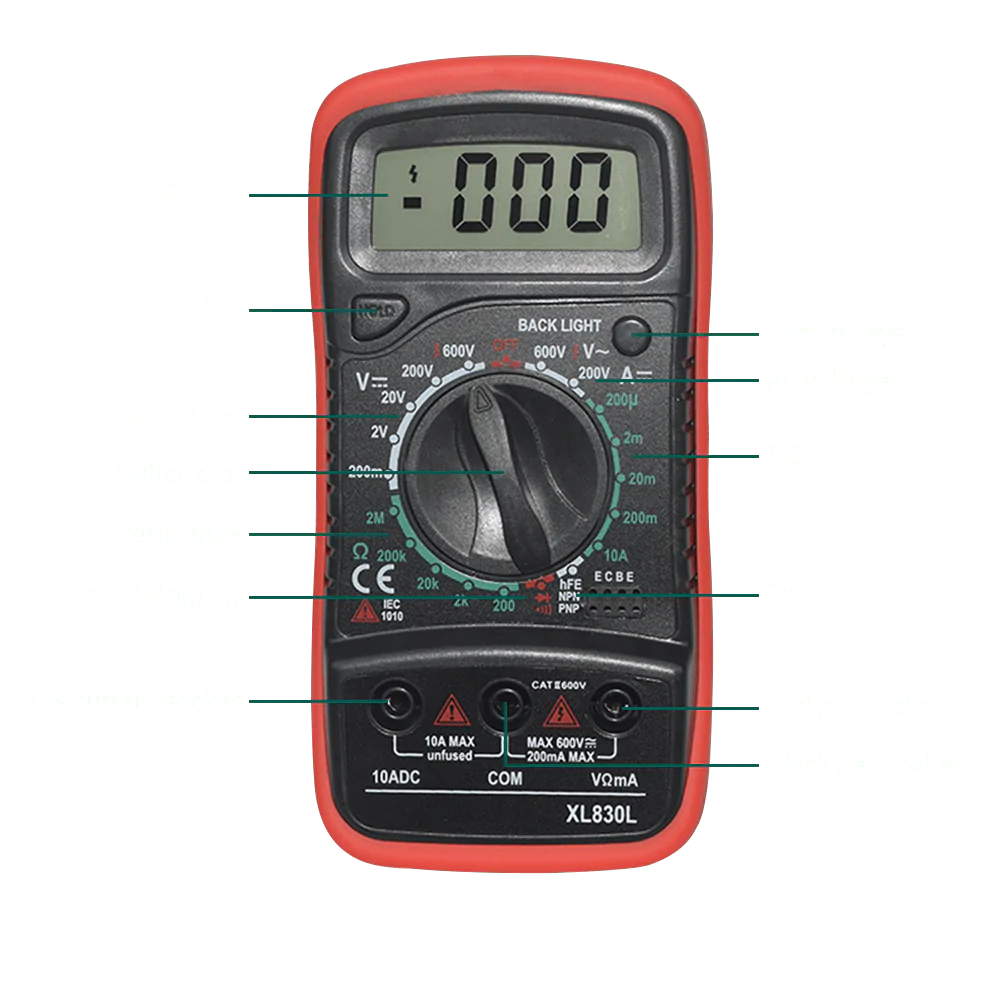

The Essential Tool for Precision Electrical Measurements
First, a high precision multimeter is indispensable for professionals who demand accurate electrical measurements. Unlike basic multimeters, precision models offer higher resolution and tighter accuracy specifications. Whether you work in electronics repair, laboratory R&D, industrial maintenance, or e-bike diagnostics, the right DMM ensures reliable readings.
What Makes a Multimeter “High Precision”?
High precision multimeters have higher resolution and better accuracy than standard models. Basic meters may offer 0.5% DC voltage accuracy with 3.5 digits. Precision instruments achieve 0.05% or better with 5.5 or 6.5 digit resolution.
| Specification | Standard DMM | High Precision DMM |
|---|---|---|
| Display digits | 3.5 – 4.5 | 5.5 – 6.5 |
| DC voltage accuracy | 0.5 – 1.0% | 0.012 – 0.05% |
| Resolution | 1mV typical | 1µV typical |
| Basic price | 30–100 | 200–1,000+ |
The higher resolution lets you see small changes in readings. The better accuracy gives you confidence in your measurements.
Counts and Digits: Understanding Display Specifications
Multimeter resolution is described by “counts” or “digits.” A 6,000 count meter can display up to 6,000 units. A 20,000 count meter offers four times more detail. For precision work, look for 20,000 counts or higher.
Common display specifications:
- 3.5 digit (6,000 count): Basic home use
- 4.5 digit (20,000 count): Pro field service
- 5.5 digit (240,000+ count): Lab precision
- 6.5 digit (1,200,000+ count): Metrology grade
The 4.5 digit mode on instruments like Fluke 87V MAX provides 20,000 counts for precise field measurements . When you need more, 5.5 digit bench meters offer 240,000 counts or higher.
True RMS Measurement Explained
True RMS (Root Mean Square) meters accurately measure non-sinusoidal AC waveforms. Standard averaging meters assume pure sine waves and can be 40% off on distorted signals. True RMS units calculate the true heating value of any waveform.
Applications needing True RMS:
- Variable frequency drives (VFDs)
- Switch-mode power supplies
- LED lighting circuits
- Motor drives and inverters
- E-bike controllers
Fluke 87V MAX and Klein Tools CL800 both offer True RMS for industrial applications .
Leading High Precision Brands
Fluke dominates the professional market with the 87V series. The 87V MAX features 0.05% DC accuracy and 20,000 count display . This model handles industrial environments with drop-proof and waterproof construction.
AIM-TTi offers 5.5-digit bench meters like the ADM1055 (0.02% accuracy) and 1908 series . The ADM1055 features a touchscreen interface with histogram and statistical display modes .
GW Instek recently launched the GDM-9052 with 0.012% DC accuracy and A.I. signal identification . The dual measurement mode shows two parameters simultaneously.
Rohde & Schwarz provides the UDS series with 6.5-digit resolution and 0.0075% basic accuracy . These represent the highest precision tier for metrology applications.
Field Service vs. Lab Bench Models
Field service meters prioritize portability and ruggedness. The Fluke 28-II Ex is intrinsically safe for hazardous locations . The Fluke 87V MAX offers industrial durability with a holster and magnetic hanger .
Bench meters prioritize precision and connectivity. The AIM-TTi 1908 has a 5.5 digit display and dual measurement capability . It can run on internal rechargeable batteries. USB, RS232, and LAN interface enable remote control and data logging.
The GW Instek GDM-9052 features 320 readings/second speed and digital I/O for automation . Its A.I. technology automatically identifies signal type without manual range selection.
Precision for E-Bike Diagnostics
E-bike troubleshooting requires accurate measurements for battery packs, controllers, and motors. A 36V or 48V battery needs precise voltage monitoring. The Hall effect sensors in hub motors require mV resolution.
Key measurements for e-bikes:
- Battery voltage under load
- Controller output waveforms
- Throttle signal voltage
- Brake cutoff continuity
- Motor phase resistance
- Charger output voltage
High precision meters help diagnose intermittent problems. mV resolution can identify weak battery cells. Capacitance testing checks motor phase health.
Safety Ratings and Certification
Safety matters when working with high voltages. CAT ratings indicate protection against voltage transients. CAT II applies to household appliances. CAT III covers industrial equipment and distribution panels.
| Rating | Application | Max Voltage |
|---|---|---|
| CAT II | Wall outlets, household | 600V |
| CAT III | Distribution boards, industrial | 600V |
| CAT IV | Utility connections | 300V |
The Fluke 28-II Ex holds ATEX certification for hazardous locations . The iFixit DMM offers CAT III 500V rating for electronic repair . Never use uncertified meters on high-energy circuits.
Advanced Measurement Functions
Beyond basic voltage and current, precision multimeters offer specialized functions:
Dual measurement lets you view voltage and current simultaneously. The AIM-TTi 1908 and GW Instek GDM-9052 both support this feature . Three measurements can display together on Rohde & Schwarz UDS models .
Temperature measurement uses thermocouple probes. The Fluke 87V MAX measures -200°C to +1090°C . This is essential for diagnosing overheating components.
Capacitance testing checks capacitors on circuit boards. The 1µF to 9,999 µF range on Fluke models covers e-bike controllers . For in-circuit testing, the EEV-ESR-Meter-Mk2 specializes in measuring equivalent series resistance .
Frequency and duty cycle measurements handle pulse-width modulation signals. E-bike throttles output varying frequency signals. The 0.5 Hz to 200 kHz range covers most applications .
Data Logging and Connectivity
Modern precision meters connect to computers for data logging. USB is standard on most bench meters. LAN and GPIB provide integration into automated test systems.
The AIM-TTi ADM1055 includes free Test Bridge software for remote control and multi-instrument management . The GW Instek GDM-9052 supports USBCDC and USBTMC for flexible PC connectivity .
For field work, manual data logging may suffice. The Min/Max/Avg recording on Fluke models captures signal fluctuations over time . Peak capture records transients as short as 250 microseconds.
Resolution and Sensitivity
High resolution reveals small signal changes. The AIM-TTi ADM1055 measures down to 1µV, 1mΩ, 10nA, and 0.01Hz . The 1908 series offers 1µV and 0.1µA resolution .
For most field work, 1mV and 0.1mA resolution prove adequate. For electronics repair, µV and µA resolution are essential.
The Fluke 87V MAX switches to 4.5 digit mode (20,000 counts) for precise measurements . This gives ten times more resolution than standard 3.5 digit mode.
Accuracy Specifications
Accuracy is often listed as ±(percentage of reading + counts). For a 5.000V reading with ±(0.05% + 1 count) specification:
- 0.05% of 5.000V = 0.0025V
- 1 count = 0.001V (on 6000 count display)
- Total uncertainty = ±0.0035V
Basic DC accuracy ranges:
- 0.012%: GW Instek GDM-9052 (6.5-digit)
- 0.02%: AIM-TTi bench meters
- 0.05%: Fluke 87V MAX and 28-II Ex
- 0.05%: Fluke 115
- 0.7%: iFixit DMM (hobbyist grade)
For e-bike diagnostics, 0.5% accuracy is usually sufficient. For precision electronics repair, 0.05% or better is recommended.
What to Look For in a High Precision Multimeter
Consider your primary applications before selecting a meter. Field service benefits from rugged construction and magnetic hangers. Lab work requires high accuracy and connectivity options. Electronics repair needs capacitance and dual measurement features.
Essential features checklist:
- True RMS for accurate AC measurements
- Auto-ranging for convenience
- Backlit display for low-light work
- CAT III safety rating minimum
- Temperature measurement capability
- Data hold and Min/Max recording
- Replaceable test leads
- Battery indicator and auto shut-off
Nice-to-have features:
- Bluetooth or USB connectivity
- Dual display for simultaneous measurements
- Built-in stand or magnetic strap
- Non-contact voltage detection
- Low impedance mode for ghost voltage elimination
- Capacitance testing up to 10,000µF
The EEV-ESR-Meter-Mk2 for Capacitor Diagnostics
For advanced electronics repair, consider the EEV-ESR-Meter-Mk2 . This specialized tool measures Equivalent Series Resistance (ESR) in capacitors. Unlike standard capacitance tests, ESR reveals failing capacitors that still show correct capacitance values.
The meter allows in-circuit testing without desoldering. Its 0.01 to 99 ohm range covers most diagnostic scenarios. This tool is unmatched for finding bad capacitors in power supplies and motherboards .
Precision Multimeter Recommendations
Fluke 87V MAX (Field Pro):
- 20,000 count display
- 0.05% DC accuracy
- True RMS AC+DC
- IP67 waterproof/dustproof
- Drop-proof to 4 meters
GW Instek GDM-9052 (Lab Precision):
- 5.5-digit resolution
- 0.012% DC accuracy
- A.I. auto-identification
- Dual measurement mode
- 320 readings/second speed
AIM-TTi 1908 (Portable Lab):
- 5.5 digits, 0.02% accuracy
- Dual display with dual measurement
- Internal rechargeable battery
- USB, RS232, LAN options
Fluke 28-II Ex (Hazardous Areas):
- Intrinsically safe for ATEX zones
- 0.05% DC accuracy
- 6,000/19,999 count display
- -200°C to +1090°C temperature
Klein Tools CL800 (Clamp + DMM):
Calibration and Accuracy Maintenance
Precision meters require periodic calibration to maintain specifications. ISO calibration certificates are available from manufacturers. The PCE-DC1-ICA comes with an ISO calibration certificate .
Calibration intervals:
- High-precision lab meters: 6-12 months
- Field service meters: 12-24 months
- General purpose DMMs: 24-36 months
Signs of calibration drift:
- Readings differ from known voltage sources
- Measurements don’t zero properly with shorted leads
- Unexpected fluctuations in stable circuits
Pros of High Precision Multimeters
- 0.012-0.05% DC accuracy for confident results
- 1µV resolution reveals subtle circuit behavior
- True RMS handles any waveform shape
- 20,000+ counts show more detail
- Data logging for trend analysis
- Remote control via USB/RS232/GPIB
- Dual measurement saves time
- Safety rated for CAT III/IV environments
- Temperature measurement included
- Capacitance and frequency standard
Cons
- High cost (200−1,000+ versus 30−100 for basic meters)
- Steeper learning curve for advanced features
- Bulkier than compact basic meters (bench models)
- Overkill for casual home use
- Calibration adds ongoing cost
Who Needs a High Precision Multimeter?
A high precision multimeter is essential for:
- Electronics repair technicians – Diagnose circuit board failures
- R&D engineers – Characterize device performance
- E-bike and EV mechanics – Test battery packs and controllers
- Industrial maintenance – Troubleshoot VFDs and motor controls
- Educational labs – Teach measurement fundamentals
- Hobbyist electronics builders – Verify component values
Why Choose a High Precision Multimeter?
In conclusion, a high precision multimeter delivers the accuracy and resolution needed for serious electrical work. The 0.05% accuracy of professional models gives you confidence in every measurement. True RMS capability ensures correct readings on modern electronic circuits. Safety ratings protect you during high-voltage testing.
For e-bike owners, precision measurements diagnose battery health and controller problems. For electronics repair, high resolution reveals subtle circuit issues. For lab work, data logging and connectivity support thorough documentation.
Basic homeowners may do fine with budget models for simple tasks. But for professionals and serious hobbyists, a high precision multimeter is an investment that pays for itself through faster, more accurate diagnostics.
For more options, browse our Collection of Test and Measurement Equipment or read our E-Bike Diagnostics Guide for practical testing tips.