The Brain of Your Electric Bicycle
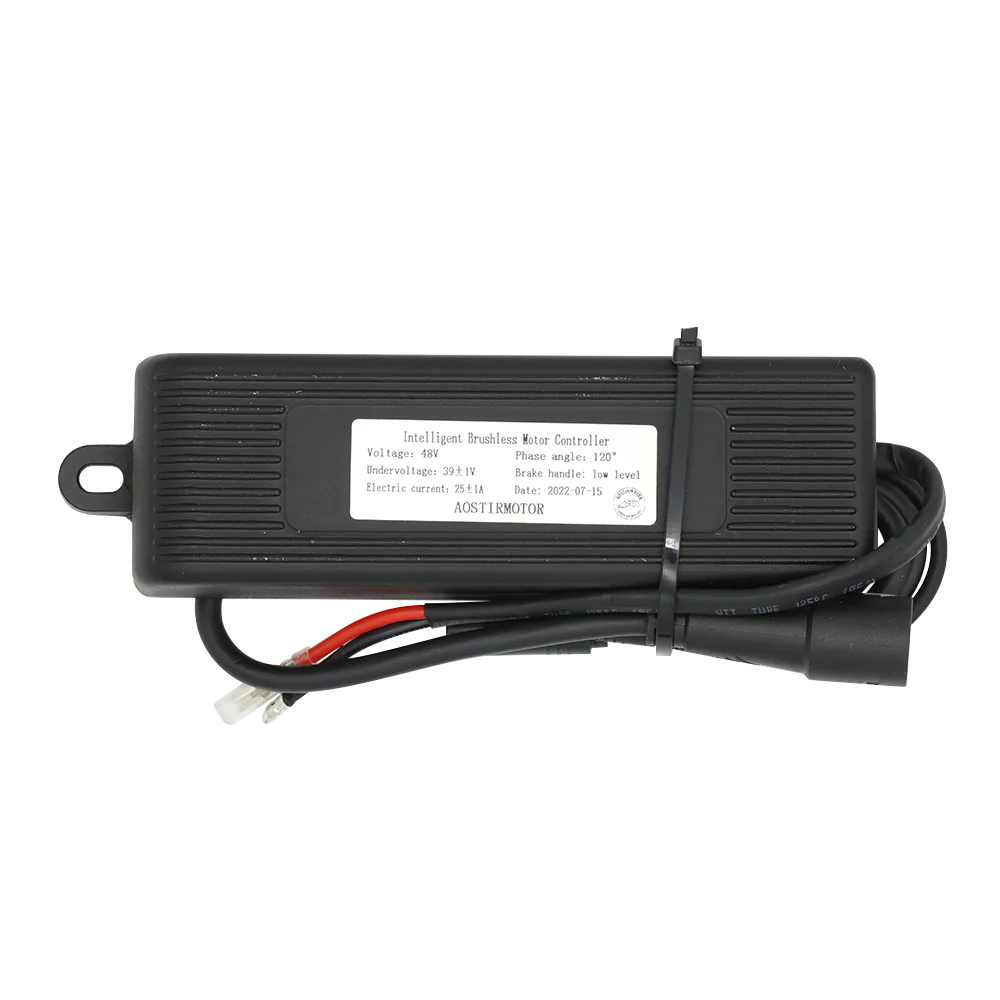
First, a 48V ebike controller is the electronic brain that manages power flow from your battery to the motor . Whether you’re building a DIY e-bike, replacing a faulty unit, or upgrading for better performance, the controller determines how your bike accelerates, climbs hills, and conserves battery life.
Voltage and Power Compatibility
Most 48V controllers support a voltage range of 36V to 54.6V (fully charged 48V battery) . The controller’s current rating (measured in amps) directly affects your bike’s power output . Use this formula: Battery Voltage (V) × Current Limit (A) = Power (W) . For example, a 48V controller with 20A limit delivers 960W peak power.
Common power ratings:
| Controller Rating | Current | Typical Motor |
|---|---|---|
| 500W | 10-15A | 350W-500W hub motor |
| 750W | 15-20A | 500W-750W motor |
| 1000W | 20-25A | 750W-1000W motor |
| 1500W | 25-35A | 1000W-1500W motor |
Controller Types: Sine Wave vs. Square Wave
Sine wave controllers (FOC – Field Oriented Control) provide smoother, quieter operation and better efficiency . They deliver natural pedaling feel and reduced motor noise. Square wave controllers cost less but produce more vibration and audible hum during acceleration. For most riders, sine wave controllers offer the best riding experience.
Key Features to Look For
A quality 48V ebike controller should include these essential features:
- Low Voltage Protection (LVP) – Prevents battery over-discharge by cutting power at 42V for 48V systems
- Overcurrent Protection – Shuts down if current exceeds safe limits
- Thermal Protection – Reduces power or shuts off when overheating
- Waterproof Rating – Look for IP65 or higher for all-weather riding
- Sensorless Operation – Allows motor to run even if hall sensors fail
Display Compatibility
Most 48V controllers work with LCD displays that show speed, battery level, and assist settings . Popular display protocols include:
| Protocol | Compatibility | Common Displays |
|---|---|---|
| KT Protocol | Kunlun Technology controllers | SW900, LCD3, LCD5 |
| UART | Universal Asynchronous | M5, various OEM units |
| CAN Bus | High-end systems (Bafang) | EggRider, DP C18 |
Important: Displays and controllers must use the same communication protocol .
Wiring Guide for 48V Controllers
Standard color codes help you connect your controller correctly :
Power Wires:
- Red – Battery positive (48V DC)
- Black – Battery negative (Ground)
- Yellow – Key switch (ignition)
Motor Phase Wires (Thick):
- Green – Motor phase A
- Blue – Motor phase B
- Yellow – Motor phase C
Hall Sensor Wires (Thin – 5-pin connector):
- Red – +5V sensor power
- Black – Sensor ground
- Green – Hall sensor A
- Blue – Hall sensor B
- Yellow – Hall sensor C
Throttle Wires (3-pin):
Brake Wires:
- Yellow or Brown – Brake signal (short to ground activates brake cutoff)
PAS (Pedal Assist System) Setup
The PAS sensor detects pedaling motion and tells the controller to provide assistance . Most systems offer 5 or 9 assist levels, with level 1 providing minimal boost and level 5 delivering maximum power . Higher-end controllers use torque sensors (measure how hard you pedal) rather than cadence sensors (measure pedaling motion only) .
Programming Your 48V Controller
Using an LCD display like the SW900, you can adjust key parameters :
| Parameter | Function | Typical Setting |
|---|---|---|
| P01 | Battery voltage | 48 for 48V systems |
| P02 | Motor phase angle | 3 (120 degrees) |
| P03 | Wheel size | 26 for 26-inch wheels |
| P04 | Speed sensor magnets | Based on motor spec |
| P05 | Speed limit (km/h) | 25-45 depending on laws |
| P06 | Low voltage protection | 42V for 48V battery |
| P07 | PAS strength | 1-100 (higher = stronger) |
Always disconnect power before plugging or unplugging the display .
Common 48V Controller Specifications
| Parameter | Typical Range |
|---|---|
| Input Voltage | 36V-48V (up to 54.6V charged) |
| Low Voltage Cutoff | 42V (±0.5V) |
| Max Continuous Current | 15-30A |
| Peak Current (Boost) | 25-40A for 30 seconds |
| Dimensions | 88-100 × 46-57 × 30-33 mm |
| Waterproof Rating | IP65 (splash-proof) |
| Operating Temp | -20°C to +105°C |
Troubleshooting Common Issues
Motor won’t start:
- Check battery voltage (should be above 42V)
- Verify hall sensor connections match colors
- Test throttle signal voltage (0.8V minimum, 4.8V maximum)
Motor runs backward:
- E01 – Motor hall sensor error (check 5-pin connector)
- E07 – Controller over-temperature (allow to cool)
- E09 – Over-current protection (check for short circuit)
DIY vs. Pre-built Controllers
Pre-built controllers from brands like Ananda, Bafang, or KT offer plug-and-play installation with matched displays . DIY open-source controllers (VESC, Solo UNO) allow custom programming but require technical expertise .
For most riders, a pre-built 48V controller with matching display provides the best balance of performance and ease of installation.
Pros of a Quality 48V Controller
- Compatible with both 36V and 48V systems for flexibility
- Programmable parameters for custom tuning
- Multiple protection features (LVP, overcurrent, thermal)
- Quiet FOC/sine wave operation on premium models
- Works with PAS, throttle, or both
- IP65 waterproof rating for all-weather riding
- Cruise control and walk-assist modes
- Regenerative braking on some models
Cons
- Budget controllers may use low-quality MOSFETs
- Some require specific display brands for programming
- Installation requires basic electrical knowledge
- Cheap units lack proper thermal management
48V Ebike Controller: Complete Specifications
Electrical Specifications
| Specification | Value |
|---|---|
| Input Voltage | 36V-48V DC |
| Low Voltage Cutoff | 42V ±0.5V |
| Max Continuous Current | 15-30A (model dependent) |
| Peak Current | 25-40A |
| Min Throttle Signal | 0.8V |
| Max Throttle Signal | 4.8V |
Physical Specifications
| Specification | Value |
|---|---|
| Dimensions (typical) | 88-100 × 46-57 × 30-33 mm |
| Weight | 250-350 g |
| Enclosure Material | Aluminum / Alloy |
| Waterproof Rating | IP65 |
Connector Types
| Function | Connector | Wire Colors |
|---|---|---|
| Battery | Bullet / XT60 | Red (+), Black (-) |
| Motor Phase | Bullet (3x) | Green, Blue, Yellow |
| Hall Sensor | JST 5-pin | Red, Black, Grn, Blu, Yel |
| Throttle | JST 3-pin | Red, Black, Blue/White |
| PAS | JST 3-pin | Red, Black, Yellow/Green |
| Brake | JST 2-pin | Yellow, Black |
| Display | JST 5-pin | Red, Black, White, Green, NC |
Motor Compatibility
| Parameter | Requirement |
|---|---|
| Motor Type | BLDC (Brushless DC) |
| Sensor Type | Hall sensor (5-wire) |
| Sensorless Operation | Yes (select models) |
| Phase Angle | 60° or 120° (auto-detect) |
Who Needs a 48V Controller?
A 48V ebike controller is perfect for:
- DIY builders converting a standard bicycle into an e-bike
- Bike owners replacing a failed original controller
- Upgraders seeking more power or better display features
- E-bike mechanics needing spare parts for repairs
- Anyone building a 500W-1500W electric bike project
Why Choose the Right 48V Controller?
In conclusion, selecting the 48V ebike controller that matches your motor and battery specifications ensures reliable performance and longevity . The controller’s current rating must align with your motor’s power requirements – too little current limits performance, while too much risks overheating the motor .
For a smooth riding experience, choose a sine wave controller with LCD display compatibility . For maximum reliability, look for IP65 waterproofing and thermal protection features . When upgrading, verify that your display uses the same communication protocol (UART, KT, or CAN) as your new controller .
If you’re building or repairing an electric bike, a quality 48V controller transforms your riding experience with responsive throttle, smooth pedal assist, and reliable protection systems.
For more options, browse our Collection of E-Bike Controllers or read our DIY E-Bike Build Guide to find your perfect match.